Just the crown — do you need a full hair system?
If your hairline is holding and the only real change is a thinning patch at the crown, a full-coverage system can be more than you actually need. Here's how a smaller, partial system works, who it suits, and how it compares.
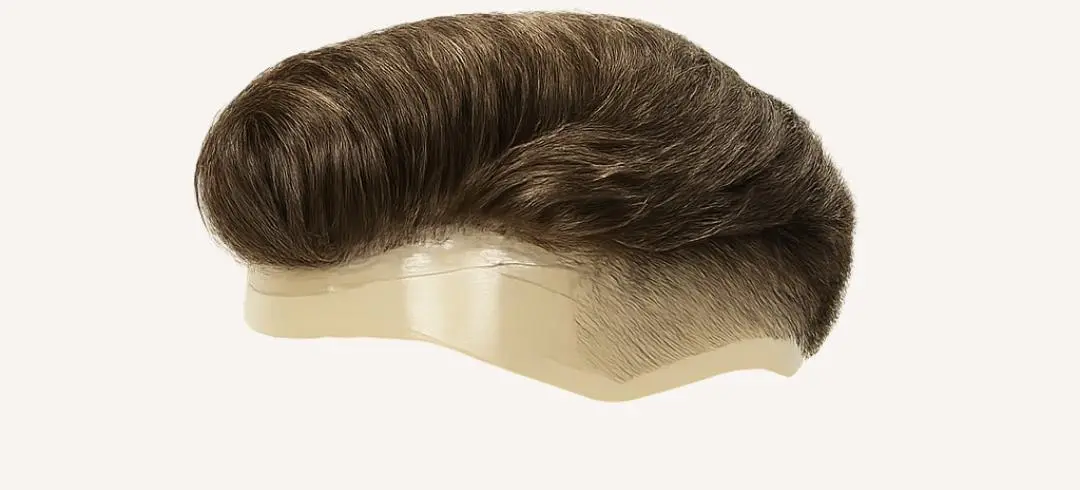
Most of the questions we get about hair systems assume the whole top of the head needs covering. But plenty of men who come in for a consultation have a much narrower problem: the hairline hasn't moved, the sides and temples look exactly as they always have, and the only real change is a thinning or bald patch at the crown — the bit you can't easily see yourself in a mirror, but notice in photos taken from behind. For that pattern, a smaller partial system is often the better fit than a full one, not a compromise.
What a partial system actually is
It's the same product, built smaller. A partial piece is hand-knotted with real human hair onto a fine base — silk, lace or a hybrid mesh, the same three options used for a full hair system — and bonded to the scalp the same way. The difference is simply size and shape: instead of covering the whole top of the head, it's cut to the exact footprint of the thinning area, most commonly an oval or circle over the crown, and blended into the natural hair that still surrounds it on every side.
Who this actually suits
The clearest sign a partial system is the right call is pattern, not preference: a hairline and temples that haven't receded, with the loss concentrated at the crown. On the Norwood scale, that's the picture behind what's sometimes called a Stage 3 Vertex pattern — the hairline holds, but the crown (the vertex) starts to thin. Receding hairline & thinning crown options covers the fuller picture of what to do at either location; a partial system is specifically the hair-system route for the crown-only version of that question.
It also depends on what's left to blend into. A partial piece needs genuinely strong, healthy hair surrounding the area it covers — that's what hides the join and carries the style. If loss has already started spreading toward the hairline or temples, there may not be enough left around a partial piece to blend it convincingly, and a full base usually makes more sense at that point.
The blending comes from the fitting, not the size. A smaller base done well disappears just as completely as a full one.
How it blends and holds
Colour, density and the direction the hair is knotted are all matched to your own surrounding hair at the join, the same careful matching process used for a full base. Done properly, the transition from your own hair into the piece is very hard to spot, even up close — there's no shortcut version of this step just because the piece is smaller. It's bonded the same way a full system is, and sits on the same four-to-six-week maintenance cycle.
Pricing — why we won't guess at a figure
We deliberately haven't put a number on this page. Coverage needed for a crown-only pattern varies a lot from person to person, and quoting a blanket "partial system" price without seeing your actual pattern would mean guessing. The honest answer is the same one we give for every pattern of loss: bring it to a free consultation and you'll walk out with a real figure for exactly what you need, not an estimate based on a generic rule.
In short
- A partial system is the same hand-knotted, bonded construction as a full one, just sized to cover only the thinning area — usually the crown.
- It suits a pattern where the hairline and temples are intact and the loss is concentrated at the crown, with strong hair left to blend into.
- The blend quality comes from careful colour, density and direction matching at the join, not from the piece being smaller.
- We don't quote by base size — a free consultation gives you an exact figure for your own pattern.
- If loss spreads later, moving from a partial piece to a full base is a straightforward next step, not a restart.
Not the same as other options for the crown
A partial hair system isn't the only route for a thinning crown. Scalp micropigmentation can mimic the look of close-cropped density over the area, but it's pigment, not real hair, and adds no length or texture to style. A transplant can work if there's a strong donor area and the loss has settled, but it's surgical and permanent. A partial system sits between the two: real hair, reversible, fitted in a single visit — honest trade-offs either way, and we'll tell you plainly which one actually fits your pattern.
Quick answers
What is a partial hair system? A smaller base, hand-knotted with real human hair the same way a full system is, but sized and shaped to cover just the thinning area — most often the crown — rather than the whole top of the head. It's bonded to the scalp in the same way and blended into the hair you still have around it, so there's no obvious line between the two.
Who actually suits a partial system rather than a full one? Generally someone whose hairline is still intact and whose loss is concentrated at the crown, with enough strong natural hair surrounding it to blend into. It's the same picture as a Norwood Stage 3 Vertex pattern. The moment loss has spread to the hairline or temples too, a full system usually makes more sense, since a partial piece can only cover the area it's cut to.
Does a partial system cost less than a full one? We don't quote by base size the way some suppliers do. Bring your own pattern of loss to a free consultation and we'll give you an honest, exact figure for what you actually need — not a guessed price based on a general rule.
Will the edge of a partial system be visible against my own hair? A well-fitted partial system is colour-matched, density-matched and cut to follow your own hair's direction right at the join, so the transition is very hard to spot, even up close. It's the same hand-knotted, bonded construction as a full system, just smaller — the blending quality comes from the fitting, not the size.
Can I move from a partial system to a full one later if my hair loss spreads? Yes. Hair loss from the crown outward is common, and if yours progresses beyond what a partial piece covers, moving up to a full base is a straightforward next step at a future visit — nothing about starting with a partial system locks you into it.
Not sure which you need?
Bring your pattern to a free, private consultation — we'll tell you honestly whether a partial system covers it, or whether a full base is the better call, and give you a real price either way.
Book a free consultationFind us at our Wolverhampton hair systems studio and our Sedgley studio.