What is a hair system? From the hands that make them.
Most explanations are written by people who haven't fitted one. This one isn't. Here's the straight answer — what the base is, how the hair is attached, why the good ones disappear, who they help, and who they honestly don't.
Every week we see clients who have spent months reading about hair systems online and still arrive at the consultation unsure exactly what they are. Not because the information isn't out there — it is — but because most of it is written at a distance, by people drawing on other written sources rather than from the experience of making and fitting them. So this is our attempt to explain it properly, from the studio floor.
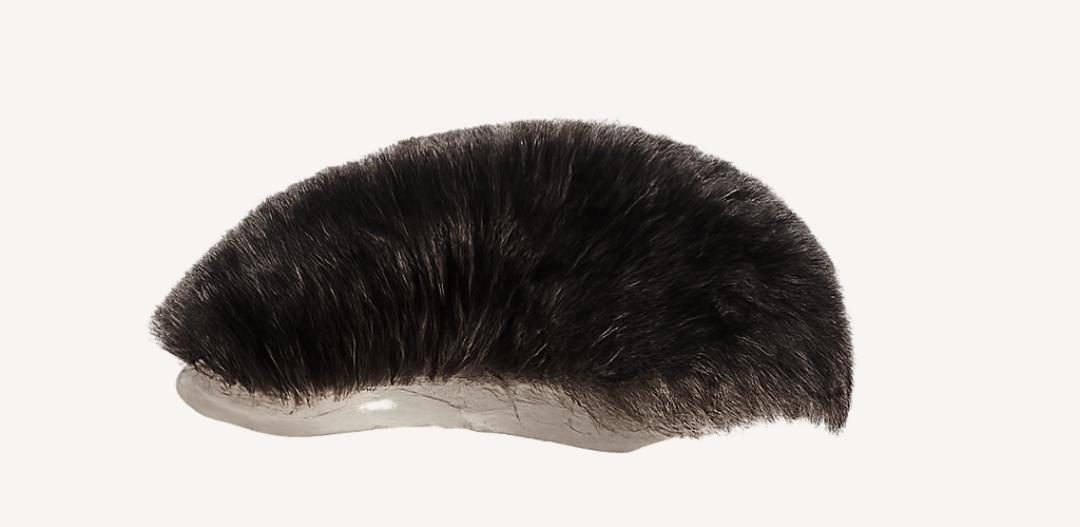
The short definition: a hair system is a thin, breathable base — made from silk, lace or a hybrid mesh — into which real human hair has been hand-knotted, strand by strand, matched to your colour, density and natural hair characteristics. That base is bonded to the scalp with a skin-safe adhesive and then cut and styled into your existing hairline by a specialist. When it is done right, you walk out of the fitting with a full head of hair and the join is invisible. It is non-surgical. No needles, no scarring, nothing implanted. The transformation happens in a single appointment. You'll sometimes see it called a "hair integration system", "hair unit" or "hair patch" instead — different names, same product.
Non-surgical. No scarring. Nothing implanted. The transformation happens in a single appointment.
What a hair system is not
The word "toupee" still does a lot of damage, and it earned its reputation honestly. Hairpieces made and sold from the 1960s through to the 1990s were, by modern standards, significantly limited: synthetic fibres that didn't move naturally, bases thick enough to create a visible ridge at the hairline, adhesives that failed in heat and humidity. The category accumulated a set of jokes that never quite went away.
A modern hair system is a structurally different thing. The base materials alone tell you that — Swiss lace as fine as 0.03 mm in places, compared with the heavier canvases used in older pieces. Mono silk that mimics the look of scalp beneath hair. Remy human hair, meaning all the cuticles run in the same direction, which is why it moves and falls naturally rather than tangling against itself. These are genuine material differences, not marketing language.
It is also not a wig. Wigs are designed to be removed. A hair system is designed to be lived in — showered in, slept in, trained in, swum in. The bond is medical grade and water-resistant. The base breathes against the scalp without creating visible edges. The distinction matters because it changes the category of thing you are wearing and, more importantly, how you are able to think about it day to day.
How the craft actually works
The part of hair system construction that determines everything — and that almost no consumer-facing writing explains — is the ventilation. Ventilation is the process of knotting each individual strand of hair through the base, one strand at a time, using a tiny hook. A full system can contain 50,000 to 100,000 individual knots depending on the density required and the coverage area. At the pace skilled technicians work, that process typically takes 60 to 90 hours per system.
At the hairline, technique matters enormously. Skilled technicians will bleach the knots along the front edge of the base so the small attachment point — which would otherwise show as a dark dot against the skin — becomes transparent. Some use single-knotted ventilation at the hairline, where each strand is looped once rather than twice, because a single knot lies fractionally flatter. Ghost knots — placed at irregular intervals and angles rather than in a regular grid — mimic the natural randomness of how hair grows from the scalp.
These are very small things. But they are precisely what separate a result that reads as immediately artificial from a result that gives someone pause, and a result that gives someone pause from one that nobody notices at all.
How common hair loss actually is
Hair loss is common enough that the stigma around doing something about it has never quite made sense to those of us who work with it daily. The NHS estimates that male pattern baldness — androgenetic alopecia — affects around half of all men by the age of fifty, rising to approximately 80% by eighty. It is caused by a genetic sensitivity to dihydrotestosterone (DHT), a derivative of testosterone, which progressively miniaturises the hair follicle over years until it stops producing hair altogether. The process can begin in the late teens and is often well advanced before it becomes clearly visible.
The American Hair Loss Association notes that two-thirds of men will have some degree of appreciable hair loss by 35. That figure is broadly consistent with what we observe in Wolverhampton and across the West Midlands — hair loss at scale, largely undiscussed, with a significant proportion of people doing nothing about it not because they are comfortable with it but because they do not know their options.
Alopecia UK estimates that alopecia areata — the autoimmune form, in which the immune system attacks the hair follicle — affects around 2 in every 100 people in the UK at some point in their lifetime. Unlike androgenetic alopecia, it can appear suddenly, in small patches or across the full scalp, with no predictable pattern and, for some people, no clear cause. For those with extensive or total alopecia, hair systems are one of the few practically effective options, because they work regardless of whether any active follicles remain.
Female hair loss is less frequently discussed, and tends to present differently — diffuse thinning rather than a receding hairline — which is partly why it receives less attention. The British Association of Dermatologists notes that female pattern hair loss becomes more prevalent after the menopause, though it can begin earlier. A significant proportion of our clients are women, and the fitting process and system options are identical.
The three base types — and what actually determines the right one
We fit three bases at Hair Aesthetics Club. This is not a good-better-best arrangement; each involves genuine trade-offs, and the right choice depends on what a particular person needs from it in practice.
Signature Silk — from £495. A silk mono-top with a 0.03 mm lace perimeter. The silk layer covers the ventilation knots entirely, creating the most natural-looking appearance of hair growing from the scalp — particularly under direct overhead light, which is where other bases can show their structure. It is our most durable option and tolerates the maintenance cycle well. For most people starting with their first system, this is where we begin the conversation.
Executive Lace — from £495. A full Swiss-lace construction. Bleached knots throughout, lace across the entire base. It is the lightest and most breathable of the three — some clients say they genuinely cannot feel it. The front practically vanishes against the skin when fitted and finished properly. The trade-off is that lace is more delicate; it requires more careful handling during cleaning and maintenance, and the lifespan is shorter.
Platinum Hybrid — from £495. Lace at the front for the natural hairline, and a 0.06 mm poly film around the perimeter and back for a stronger adhesive bond and added durability. It performs well for active lifestyles — sport, manual work, anything that generates significant heat and sweat. The hairline looks right; the structural parts hold up.
All three begin at £495 — there is no base-quality upsell hidden somewhere. You can read more about what each one involves in practice in our hair systems overview.
So which one fits your situation? If this is your first system and you want the most forgiving day-to-day option, Signature Silk is usually where we start the conversation — it's why most first-time clients end up there. If you train heavily, work outdoors, or generate significant heat and sweat and want a base built around a stronger adhesive bond specifically, Platinum Hybrid is designed for that demand. If breathability under the base matters more to you than raw durability — you barely want to feel it's there — Executive Lace is the lightest of the three, at the cost of needing more careful handling. None of these is objectively "better"; the trade-off between naturalism, breathability and durability is genuine, and the right answer depends on what you actually do day to day rather than on the price, since all three start at the same figure. Scalp sensitivity is a separate question from base material — it comes down to which adhesive suits your skin, which we assess individually rather than prescribe generically, so it's worth raising directly at a free consultation.
Hair system vs hair transplant — the honest comparison
The comparison comes up at almost every consultation, and it deserves a direct answer rather than a cautious one.
A follicular unit extraction (FUE) transplant harvests individual follicles from a donor area — typically the back and sides of the scalp — and implants them into the thinning area. The International Society of Hair Restoration Surgery notes that advances in FUE technique over the last decade have produced meaningfully better outcomes than earlier approaches. In the right candidate — sufficient donor hair, realistic expectations, willingness to commit to the timeline — the results can be natural and effectively permanent.
But transplants are not suitable for everyone. Advanced hair loss — Norwood stages V, VI or VII — often means there is not enough usable donor hair to achieve meaningful coverage. In all candidates, the results take 12 to 18 months to become visible, the procedure is not without discomfort, and the cost in the UK typically runs from £3,000 to £10,000 depending on graft count and clinic. Hair restoration surgery is regulated under the Health and Social Care Act in England; the quality variation between providers is wide, and it is worth researching carefully.
A hair system produces a result the same day and works regardless of how advanced the hair loss is or what caused it. Over a lifetime of continuous wear, the cumulative cost of replacement systems and maintenance is greater than a single transplant procedure. Neither is the correct answer in the abstract — they serve different needs and suit different people at different points. We cover this comparison in more depth in our article on hair systems versus transplants.
The maintenance commitment — what you actually need to know
A hair system is not permanent, and it is not maintenance-free. We say this clearly because the clients who struggle are usually the ones who weren't told upfront.
Every four to six weeks, the system needs a studio visit — a deep clean, a fresh bond, a cut and re-style. From £60 per visit. Between visits, there is a daily home routine: specialist shampoo, the appropriate adhesive products, some care around heat and friction. It becomes habit relatively quickly, but it is involvement. Clients who maintain the schedule consistently get the best from their system. Those who stretch it to eight or ten weeks typically find the bond beginning to fail and the hair losing its cut and shape.
The system also needs replacing when the base reaches the end of its life — how long that takes depends on which base you wear, how your scalp interacts with it, and how it has been cared for. We build the replacement cycle into every client's plan from the start. There are no surprises.
If you want to understand exactly what the day-to-day routine involves, our hair system care guide covers it fully, and honestly.
Who a hair system is not for
Most hair replacement content omits this section. We include it because the honest answer to "is this right for me" is sometimes no, and we would rather say that clearly than have someone arrive at the conclusion themselves after six months of frustration.
Hair systems are not the right solution for people who want to be entirely free of salon visits and ongoing care routines. The maintenance commitment is real, and if someone is not willing to hold to it, the result deteriorates in a way that becomes noticeable faster than people expect.
They are not suitable for those with active scalp conditions — psoriasis, seborrhoeic dermatitis, active fungal infections — without a GP or dermatologist involved first. We do work with clients who have these conditions, but never without medical guidance already in place. If you are managing a scalp condition, the right first conversation is with your doctor, not a studio.
And some people find that even a technically perfect system doesn't resolve the psychological dimension of wearing something. That is a legitimate response, and it is not something we can reason someone out of. If someone comes to the consultation genuinely uncertain whether they could be comfortable knowing they were wearing a system, we say so and suggest they take time before committing to anything. The consultation is there for exactly that kind of honest conversation — not to close a sale.
What happens at the consultation
Because we hear this question often: the consultation is free and takes roughly an hour. We assess the pattern and stage of the hair loss, take measurements, photograph the existing hairline and note the hair's colour, texture, wave and grey distribution. We show real base samples so you can feel the difference between silk and lace in your hands, understand what the care involves, and ask whatever you need to ask. A written quote at the end. No obligation to book, and no follow-up call unless you want one.
We work this way because it is the only foundation on which the relationship that follows makes sense. Hair systems require ongoing commitment from both sides — from us to maintain the result, from the client to keep the schedule. That does not start well if it is built on anything other than a straight conversation.
In short
- A hair system is a breathable base, hand-knotted with real human hair, bonded to the scalp and cut into your existing hairline.
- The craft — ventilation technique, bleached knots, base choice — is what determines whether the result disappears or announces itself.
- Hair loss is far more common than it is discussed: the NHS puts male pattern baldness at around half of men by 50.
- The comparison with transplants is real: surgery suits some people; a system suits others. Neither is universally correct.
- They are not right for everyone. Maintenance commitment and scalp health both matter. The consultation is where those questions get honest answers.
References
- NHS — Hair loss · nhs.uk/conditions/hair-loss/
- American Hair Loss Association · americanhairloss.org
- Alopecia UK — About Alopecia Areata · alopecia.org.uk
- British Association of Dermatologists · bad.org.uk
- International Society of Hair Restoration Surgery · ishrs.org
Come and see for yourself
The consultation is free, unhurried and carries no obligation. Come and see the bases in person, ask anything you like, and take your time before you decide anything at all.
Book a free consultation